
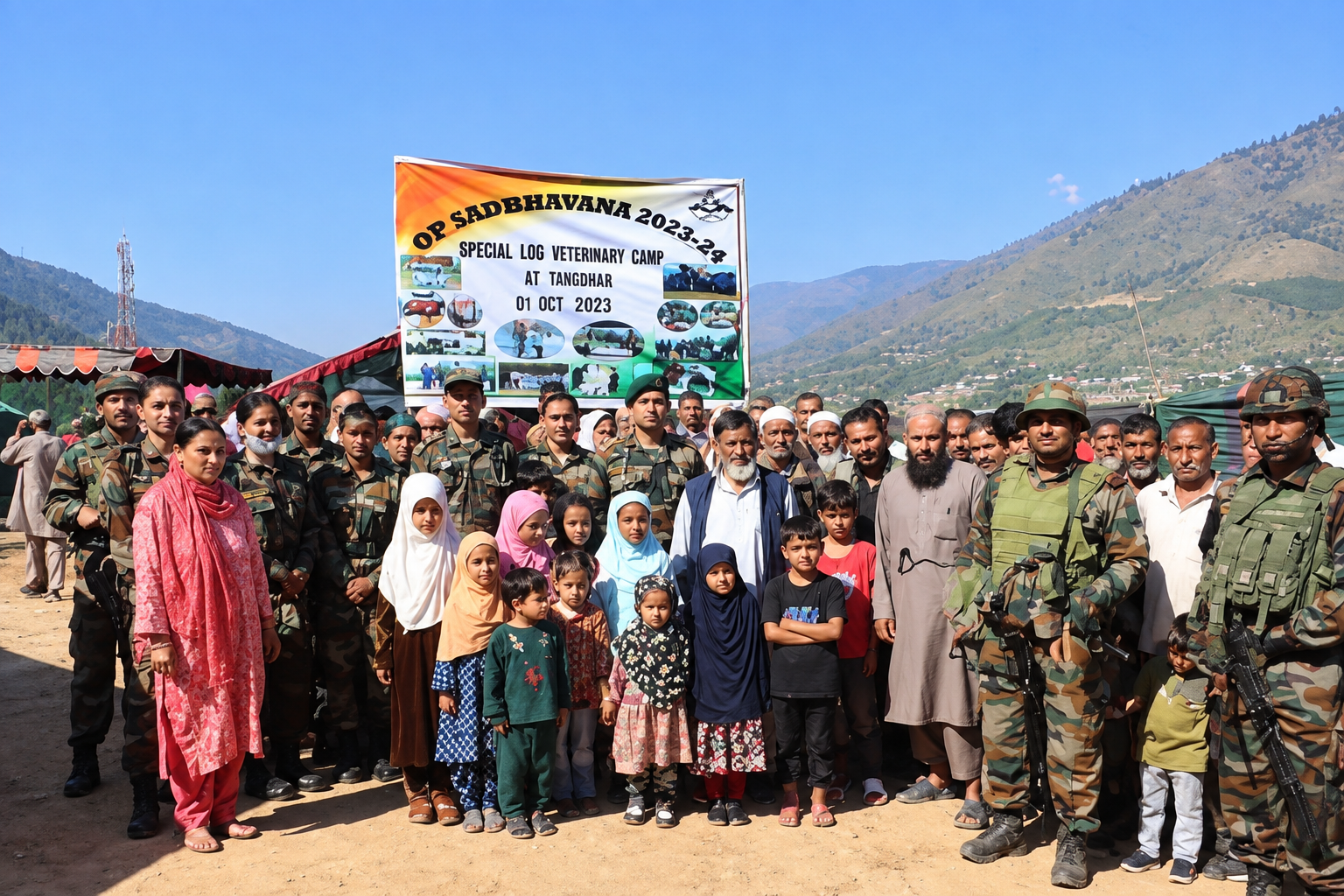
There is no doubt that the Army’s role goes beyond defence or guarding the borders, and in a place like Kashmir, the Army’s role becomes even more vital owing to harsh winters, tough geography, difficult terrain, and when we talk about remote Kashmir, the situation gets even more difficult, but that difficulty is overcome by the Army. The Army in Kashmir, especially in remote Kashmir, has been a lifesaver, an invisible helping hand since decades. Army goodwill schools, sports tournaments, border tourism, all are attributed to the Indian Army, and among those are Medical & Veterinary Camps by the Indian Army in Remote Areas. For communities residing in remote Kashmir, access to health facilities can be difficult and time consuming. In such circumstances, such camps have become an important way of taking basic healthcare services directly to people in their villages, saving time, money and lives.
If we talk about medical camps organised by the Indian Army in remote areas of Kashmir, they have proven an absolute lifeline. The Army repeatedly organises such camps where locals undergo free medical diagnoses, check-ups and receive crucial medicines at much lower prices than the market or free of cost. An elderly person who was supposed to travel 40 to 50 kms or for 3 to 4 hours, spend hundreds of rupees on fare, gets the same treatment for free with zero hassle. A poor person who cannot easily afford drugs and medical check-ups gets all of it for free at his doorstep. An old mother receives medical attention without paying anything. A remote sister gets free medical consultation without doing much. A father gets his son treated without any hassle, appointment headache, just go and get treated by the best. A patient having a skin allergy and unable to visit any health facility for reasons like a poor pocket or heavy distance gets his skin infection treated in the nearby free medical unit set up by the Indian Army. Someone’s mother who has backache gets treated. Imagine the level of happiness of those families who receive medical treatment without any appointment, rush, fee, hassle or travel, just at the doorstep. That is what such initiatives by the Indian Army bring to these families and to society. For example, places like Uri, Gurez, Machil, Karnah, which largely remain inaccessible due to snowfall and harsh winters, how can they attend any medical emergency or avail medical facilities? The answer lies in these camps, medical units set up by the Army, or even choppers provided by the Army for critical patients. In such areas, Army medical camps provide more than treatment. They contribute to preventive healthcare by creating awareness about hygiene, nutrition, common diseases and other health concerns. For families who may not regularly have access to medical professionals, an opportunity to consult a doctor locally can be valuable.
Having that said, the Army’s role is not limited to human medical care; it has expanded to cattle and livestock. The Army also organises veterinary camps in remote Kashmir. Special units of the Army organise such camps to provide medical assistance to the livestock of the remote communities of Kashmir. This has particular importance in rural Kashmir, where cattle, sheep, goats, horses and other animals contribute directly to household livelihoods. For many families in remote villages, livestock is an economic asset. Cattle can provide milk, sheep and goats can contribute to household income, while horses and other animals may be used for transportation and local economic activities. When animals fall sick, the consequences can therefore extend beyond animal welfare and affect the income and food security of an entire household. The Army organises veterinary units and free drug distribution in remote Kashmir, which helps countless families with economic and food security. Such camps raise awareness, improve hygiene, immunity and the life of the local livestock. Someone’s horse fighting an infection gets free treatment. Someone’s cow’s scar is healed by these camps. Someone’s cattle get immune to multiple infections. Such moves save families, protect their economic interests and make them live a life insulated from stress. Veterinary camps allow specialists to examine animals, provide treatment and advise owners on animal health and disease prevention. Such services areuseful especiallyin mountainous communities where veterinary facilities may be difficult to access.
So, in a nutshell, these camps collectively provide relief to remote communities. People with low mobility and affordability get treated in their localities. Free consultations are given. A medical camp can provide an initial consultation and treatment while also identifying cases that require further medical attention. Where necessary, patients can be advised to seek specialised treatment at appropriate healthcare facilities. For livestock, which is difficult to move, receiving treatment at your home is more than relief, it is a blessing. Veterinary camps are particularly important as they are tied to the economy, transportation and food security. Ultimately, the value of these camps lies in their direct impact on people and animals. In a remote village, the arrival of a medical team can mean access to a doctor without a long journey. For a livestock owning family, a veterinary team can mean timely treatment for an animal that contributes to its livelihood, and remote communities receive treatment by Army doctors, the cream and best of the nation. So, it is very safe to say the Army is the lifesaver and invisible helping hand in Kashmir, especially remote Kashmir.
Email : aaliasyed119@gmail.com


