October 22, 1947, marked a turning point in Kashmir’s history. The invasion by armed tribal raiders, their advance towards Srinagar, the suffering of civilians and the resistance organised by local forces and volunteers became defining events in the first India–Pakistan war.
A Dark Chapter in Kashmir’s History
 The history of Jammu and Kashmir is marked by political upheaval, conflict and the resilience of its people. Among its most consequential episodes was the invasion that began on October 22, 1947, when armed tribal raiders crossed into the princely state from the direction of Pakistan and advanced towards Srinagar. Coming just weeks after the Partition of British India, the invasion unfolded against a backdrop of communal violence, mass displacement and political uncertainty across the subcontinent.The episode is frequently described in Indian historical accounts as Pakistan’s first aggression against Kashmir. The expression “First War of Terror” highlights the fear and suffering inflicted on civilians, although it is an interpretative description rather than a universally accepted historical designation. Contemporary records establish that armed raiders entered the state, attacked settlements and threatened Srinagar, setting in motion events that transformed the political and military future of the region.For Kashmiris, October 1947 was not simply a confrontation between two newly independent countries. It was a human tragedy that placed ordinary people, irrespective of their religion or social background, in the path of armed conflict.
The Background to October 22, 1947
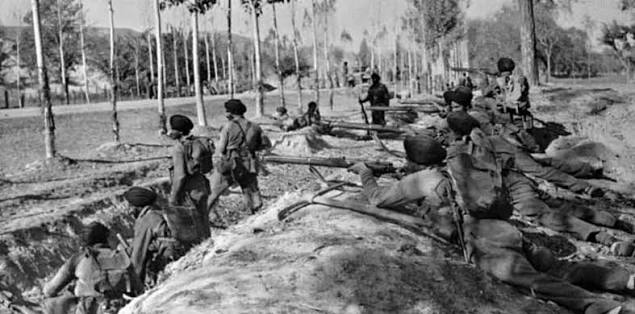
At the time of Partition, Jammu and Kashmir was a princely state ruled by Maharaja Hari Singh. India and Pakistan became independent in August 1947, but the Maharaja had not immediately decided which dominion the state would join. His administration was already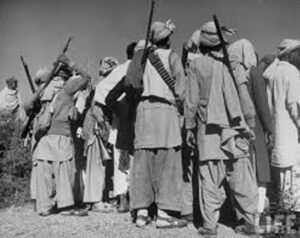 facing internal unrest, particularly in Poonch, where an armed rebellion had developed amid grievances against the ruling establishment. Partition-related violence and refugee movements further complicated the situation.Pakistan maintained that the tribal invasion was not an official military operation directed by its government. However, historical investigations, military accounts and Major-General Akbar Khan’s Raiders in Kashmir have contributed to the debate over the planning, logistical support and involvement of individuals connected with Pakistan’s military establishment. The extent of official responsibility has been contested, but the evidence has led many historians to reject the idea that the invasion was entirely disconnected from developments across the border. On October 22, armed raiders entered Kashmir through the Muzaffarabad sector, overcame positions held by the Jammu and Kashmir State Forces and advanced along the Jhelum Valley road towards Srinagar. The speed of their advance exposed the weakness of the state’s defences and created an immediate emergency for its administration.
Muzaffarabad, Uri and Baramulla: The Human Cost
The advance brought reports of killings, looting, arson and attacks on civilians. As administrative arrangements broke down in threatened areas, residents faced the loss of their homes, property and livelihoods. Families fled in search of safety, while others remained trapped amid the violence.
Baramulla became one of the most significant and tragic locations of the invasion. Situated on the route to Srinagar, the town was exposed to the advancing raiders and suffered extensive disruption. Historical accounts describe attacks on residents, the plundering of 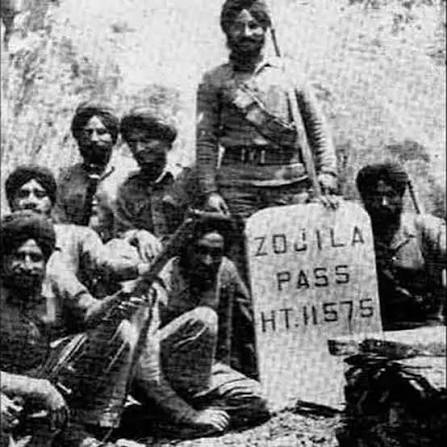 shops and homes, and the killing of civilians.The St Joseph’s Mission Hospital and Convent became a particularly painful symbol of the violence. Religious personnel, hospital workers and others associated with the mission were among those affected. Accounts of the incident, including research by journalist Andrew Whitehead in A Mission in Kashmir, document the killings and the suffering experienced at the mission complex.Baramulla also acquired strategic importance because the raiders’ stay there delayed their further advance towards Srinagar. The precise contribution of this delay must be considered alongside the wider military and political circumstances, but it gave the defending side valuable time as urgent preparations were made to protect the capital.The town’s suffering should never be reduced to a military calculation. Behind every account of destruction were families who lost relatives, residents who feared for their lives and communities whose everyday existence was shattered. Baramulla’s experience remains an essential part of Kashmir’s collective historical memory.
Historical Evidence and Contemporary Records
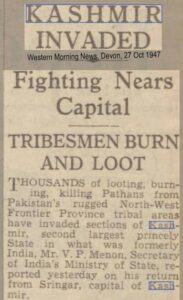
The invasion is documented in contemporary parliamentary debates, official correspondence, newspaper reports and later military histories. These sources help establish the broad sequence of events while also revealing how information was reported during a rapidly developing crisis.On October 30, 1947, the British House of Commons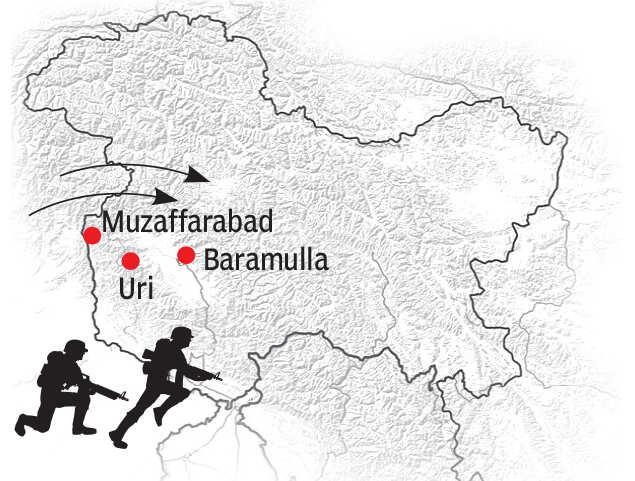 discussed the Kashmir situation. The British government’s representative, P. Noel-Baker, reported that approximately 2,000 armed raiders had entered Kashmir around October 22 and taken the Jhelum Valley road towards Srinagar. He also stated that the Maharaja had appealed to India for assistance on October 26 and sought accession to the Indian Dominion. This figure was a contemporary estimate, not a definitive count of all participants.Another important document is Jawaharlal Nehru’s cable to British Prime Minister Clement Attlee dated October 28, 1947. Nehru described the raiders’ advance, the damage reported in towns and villages, the threat to Srinagar and the emergency facing the state. He also referred to National Conference volunteers helping to maintain order in the Valley. As a contemporary communication from the Indian prime minister, the cable is valuable evidence of the Indian government’s understanding of the crisis, although its claims must be assessed in the context of wartime correspondence.These records, considered alongside independent historical research and accounts from Baramulla, help establish the broad chronology of the invasion. They also underline the importance of distinguishing contemporary estimates, documented events and interpretations of responsibility.
How Kashmiris Responded: Courage, Resistance and Solidarity
While the invasion threatened the Valley, Kashmiris were not merely passive witnesses to the unfolding crisis. Local forces, political volunteers and ordinary residents played important roles in responding to the emergency.The National Conference, led by Sheikh Mohammad Abdullah, mobilised volunteers to assist with maintaining order and supporting civil defence. Nehru’s October 28 cable specifically acknowledged their role at a time when 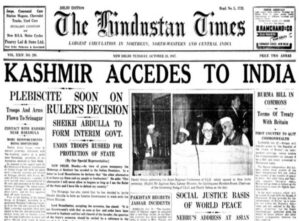 parts of the administration had broken down. The organisation also called for resistance to the invasion and support for the protection of Srinagar.The response reflected the determination of many residents to defend their homes and communities. According to Nehru’s account, people from different religious backgrounds were prepared to resist the advancing raiders despite limited access to arms. Srinagar also contained Hindu and Sikh refugees who had fled violence elsewhere, increasing the urgency of protecting the city and its inhabitants.The experiences of Kashmiris were not identical across the state. Political loyalties, local grievances and the wider violence of Partition shaped different communities’ responses. Nevertheless, the efforts of volunteers and residents demonstrate that the defence of Kashmir involved more than the actions of armies and political leaders. It also depended on people trying to preserve public order, assist vulnerable neighbours and protect their communities.Their contribution deserves recognition because it places ordinary Kashmiris at the centre of their own history rather than treating them merely as victims of events determined elsewhere.
Accession to India and the Defence of Srinagar
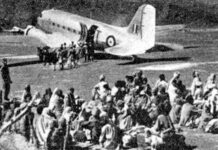
As the raiders advanced towards Srinagar, Maharaja Hari Singh’s government urgently sought military assistance from India. The Maharaja signed the Instrument of Accession on October 26, 1947, and the accession was accepted by Governor-General Lord Mountbatten on October 27, according to the established Indian official chronology.Following the accession, Indian troops were airlifted to Srinagar on October 27. Their immediate task was to secure the airport and help defend the capital against the advancing raiders. The arrival of Indian forces marked a decisive stage in the conflict and prevented the immediate capture of Srinagar.The deployment did not bring an immediate end to the fighting. Military operations continued across Jammu and Kashmir, eventually developing into the first India–Pakistan war of 1947–48. The conflict caused extensive displacement and suffering and resulted in a territorial division that continues to influence the region’s politics and security.The accession and the subsequent military intervention remain central to historical and political debates about Kashmir. However, the immediate circumstances of October 1947 are clear: the advancing raiders created an emergency, the Maharaja sought assistance, and Indian troops arrived to defend Srinagar.
Remembering October 22, 1947
The tribal invasion that began on October 22, 1947, was a turning point in Kashmir’s modern history. It exposed the vulnerability of the princely state during Partition, brought violence to towns and villages, and triggered political and military developments whose consequences continue to be felt.For Baramulla, the events remain a solemn reminder of the suffering inflicted on civilians. For Kashmir as a whole, they demonstrate how quickly political uncertainty and armed violence can destroy lives and destabilise communities.The historical record also highlights the need to acknowledge the courage and contributions of Kashmiris who responded to the crisis. Local forces, National Conference volunteers and ordinary residents all formed part of the wider effort to protect communities and defend the 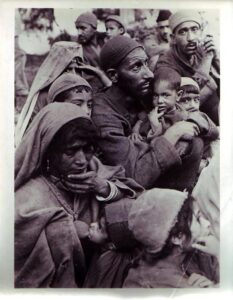 Valley.Remembering this episode should not mean promoting hostility towards ordinary people on the basis of religion or nationality. It should mean recognising the suffering of victims, examining responsibility through credible evidence and ensuring that historical accounts distinguish facts from disputed interpretations.More than seven decades later, October 22 remains a date of profound historical significance. Preserving its memory through documentary evidence, responsible journalism and respect for civilian suffering is essential to understanding Kashmir’s past and safeguarding the lessons it offers to future generations.
The author reaches at:ahmedfaraaz134@gmail.com